

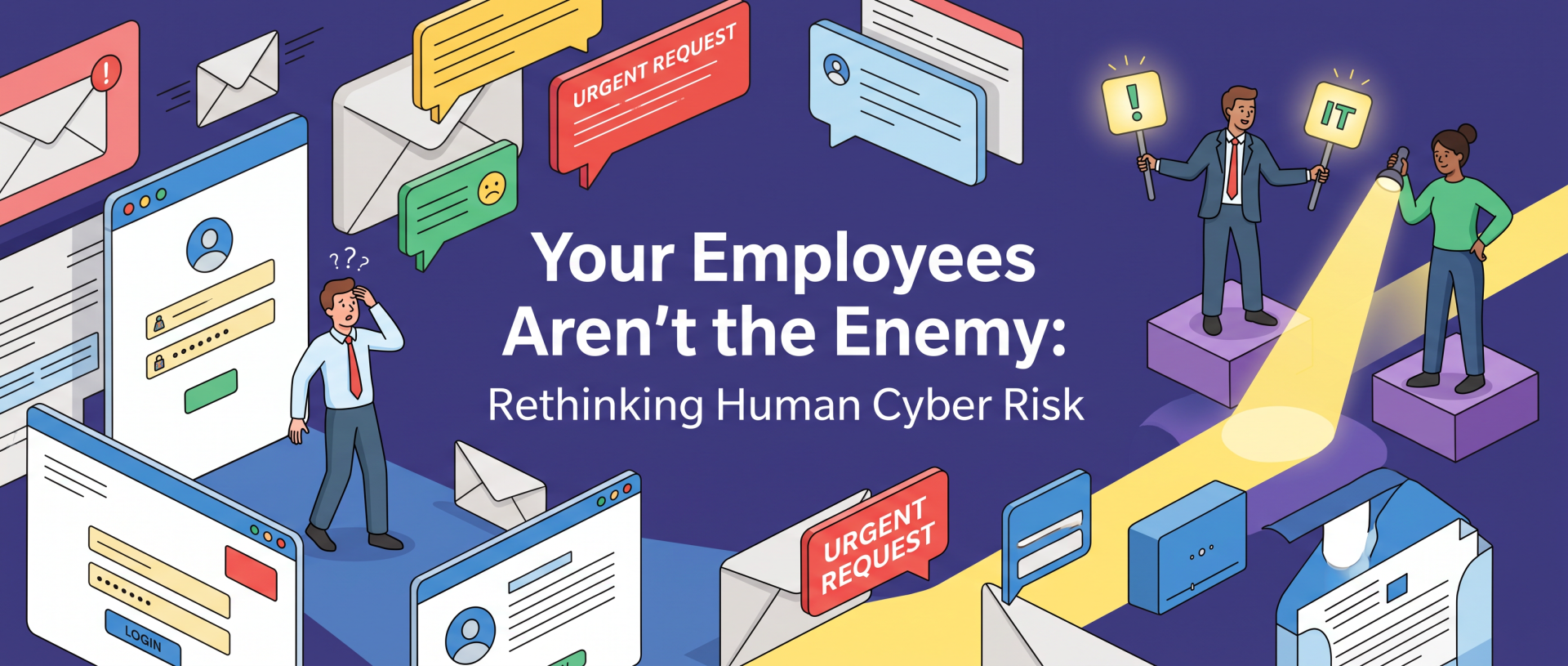
Why effective security awareness focuses on behavior and systems instead of finding someone to blame
There is a familiar scene in cybersecurity training.
An employee receives a simulated phishing email. It looks surprisingly convincing. Maybe it appears to come from a vendor they recognize. Maybe it creates just enough urgency to catch them between a customer call and three other tasks. They click.
A bright red training page appears.
You failed the phishing test.
Technically, the simulation worked. Educationally, the organization may have just taught the wrong lesson.
Instead of learning, “Here is how I can recognize this kind of attack next time,” the employee may learn something quite different: “Security is trying to catch me making mistakes.”
That distinction matters.
Cybersecurity absolutely has a human component. NIST studies user behavior during real-world phishing awareness exercises and has developed its Phish Scale specifically because simulated phishing messages vary in how difficult they are for people to detect. NIST says click rates should be interpreted in the context of that difficulty rather than treated in isolation. [csrc.nist.gov], [nist.gov], [nist.gov]
The better question, then, is not simply, “Why did Bob in accounting click?”
It is, “What made this attack believable, what can we teach people from it, and what else can we change so one click does not become a security incident?”
That is the mindset behind human risk management.
The Problem With Calling People the “Weakest Link”
People make mistakes. That statement is both undeniably true and spectacularly unhelpful as a security strategy.
Computers make mistakes too. Software contains vulnerabilities. Administrators misconfigure systems. Processes create unnecessary friction. Attackers deliberately design messages to manipulate urgency, authority, curiosity, fear, and familiarity.
Yet when someone clicks a malicious link, all that complexity can suddenly collapse into one explanation: The user messed up.
That is convenient. It is also incomplete.
NIST’s human-centered phishing research specifically considers both characteristics of a phishing email and the recipient’s context when evaluating how difficult a message is to detect. NIST has also found that messages aligned with someone’s work context can be more challenging to recognize as phishing. [csrc.nist.gov], [tsapps.nist.gov]
Imagine two phishing simulations.
One promises everyone a free luxury vacation from a company nobody has heard of.
The other appears to be a Microsoft 365 notification arriving during a week when employees really are dealing with account changes.
If ten people click each message, those identical click counts do not necessarily tell us identical things about the workforce. The second message may simply be a much better social-engineering attack.
That is part of the reason NIST created the Phish Scale: raw click rates need context. [nist.gov], [nist.gov]
Human risk management starts by recognizing that employees operate inside a system. Security improves when we make the entire system harder to exploit.
Attackers Target People Because People Have Jobs to Do
Consider how unusual normal office life actually looks when viewed through a cybersecurity lens.
Employees receive attachments from strangers because prospective customers are strangers. Finance handles payment requests because paying people is literally its job. HR opens résumés. Executives receive urgent requests. Salespeople click links sent by prospects. Employees sign into cloud services throughout the day.
Telling everyone to “never click suspicious links” sounds wonderfully simple until someone asks the obvious question:
Which links are suspicious?
CISA warns that phishing messages can contain personal or company-specific details and may even appear to come from known contacts whose accounts have been compromised. Its guidance recommends teaching employees to recognize warning signs and independently verify unexpected requests using a known contact method rather than the contact information supplied in a suspicious message. [cisa.gov]
That is a much more useful lesson than “don’t click.”
Good training gives somebody an action they can perform when uncertainty appears.
If the finance manager gets an unusual payment request from the CEO, the lesson is not, “You had better be smart enough to know whether this is fake.”
The lesson is, “Unusual payment requests get verified through an established second channel.”
Now security is not dependent entirely on someone’s suspicion at 4:52 on a Friday afternoon.
Security Awareness Training Should Build Skills, Not Fear
Security awareness training is still important. NIST’s Cybersecurity Framework 2.0 includes awareness and training within its Protect function, with outcomes addressing both general personnel and people in specialized roles. NIST also maintains dedicated awareness, training, and education resources. [csf.tools], [csrc.nist.gov]
The issue is how training is used.
A once-a-year slideshow followed by ten questions everyone desperately wants to finish before lunch may satisfy an administrative requirement. It does not automatically create better security habits.
Effective human risk management treats cybersecurity more like learning to drive.
We do not give a new driver a 45-minute PowerPoint on traffic accidents, quiz them on stop signs, hand them the keys, and declare the transportation risk permanently solved.
People learn through explanation, practice, reinforcement, experience, and feedback.
Cybersecurity benefits from the same philosophy.
CISA recommends giving employees phishing training, keeping them informed as threats change, teaching threat literacy, and ensuring they know what to do when a message seems suspicious. [cisa.gov]
Training should therefore resemble the situations people actually encounter. Someone who handles invoices faces different scenarios from someone answering a public email address. Executives, IT administrators, customer-service employees, and finance personnel may all encounter different forms of manipulation.
Same company. Different jobs. Different context.
Training can reflect that.
The Best Employee Response May Happen After the Click
There is another uncomfortable reality that security programs need to accept:
Someone will eventually make a mistake.
Maybe they click. Maybe they enter credentials before realizing something looks wrong. Maybe they download a suspicious attachment.
At that moment, the organization’s security culture becomes extremely important.
Imagine an employee realizes thirty seconds after entering their password that the page was fraudulent.
What behavior does the company want next?
The answer is obvious: report it immediately.
Now ask a harder question. Has the organization made that behavior psychologically and operationally easy?
If employees expect embarrassment, anger, public criticism, or punishment for an honest mistake, staying quiet can become tempting. From a security perspective, that is exactly the wrong incentive.
CISA explicitly tells businesses to equip staff to recognize and report phishing scams and recommends establishing clear ways for employees to get help when they are unsure whether something is phishing. [cisa.gov]
Reporting should therefore be treated as part of the defense, not an admission of defeat.
An employee saying, “I think I clicked something bad,” has just provided valuable security information. The faster the organization knows what happened, the faster its technical team can investigate and respond.
The conversation should begin with: “Thanks for telling us. Let’s take care of it.”
There will be time to figure out what happened afterward.
Measure More Than Who Clicked
Phishing simulations often produce beautifully clean numbers. Click rates look great on a dashboard.
Unfortunately, a simple number can create a very simple story.
Clicks went down? Training works.
Clicks went up? Users need more training.
Reality can be messier. NIST specifically warns against evaluating phishing programs in a vacuum and developed its Phish Scale to add the human-detection difficulty of a message to the interpretation of simulation results. [nist.gov], [nist.gov]
Organizations can therefore ask broader questions.
Did employees recognize the message? Did people report it? Which characteristics made the simulation convincing? Do certain business workflows make verification difficult? Are reporting procedures easy to find?
This turns an exercise from a trap into a diagnostic tool.
Suppose a simulated email requests an urgent change to vendor payment information. Many employees fall for it. The easiest conclusion is that the employees need remedial training.
But perhaps the more valuable discovery is that the company does not have a clear procedure for independently verifying vendor banking changes.
That is not merely a training opportunity.
It is a process opportunity.
Fixing the process can protect employees the next time a much more convincing attack arrives.
Humans Should Not Be the Only Security Control
There is a danger in taking the phrase “human firewall” too literally.
If an organization’s security strategy requires every employee to correctly identify every malicious message, every time, under every circumstance, it has created a control with an impossible reliability requirement.
Training belongs inside a layered security program.
The employee can recognize suspicious behavior. Technology can filter and restrict threats. Authentication controls can make stolen passwords less useful. Access can be limited so an unnecessarily broad compromise is less likely. Processes can require verification for sensitive transactions. Monitoring and incident response can address attacks that get through.
None of those controls makes training unnecessary.
Likewise, training does not make those controls unnecessary.
Human risk management works best when people are one valuable part of the security architecture rather than the last person standing between the company and disaster.
Make the Secure Choice the Easy Choice
Here is a useful test for any security process: How difficult is the safe behavior?
Suppose an employee suspects an email is malicious. To report it, they must find the security policy, locate an email address, manually create a new message, attach the suspicious email correctly, and explain what happened.
Or they could close the message and get back to work.
We should not be surprised which option occasionally wins.
Security teams should look for friction. The same principle applies to password practices, approval workflows, software requests, data handling, and other everyday technology decisions.
Inefficient employee behavior can be a symptom of inadequate training, confusing software, poor system design, or processes that do not match how people actually work.
That principle translates beautifully into security: Before asking why someone did the unsafe thing, ask whether the safe thing was clear, practical, and convenient.
Sometimes the problem really is a knowledge gap. Sometimes it is a badly designed workflow wearing an employee nametag.
Turn Mistakes Into Intelligence
A reported mistake is data.
If several users keep falling for password-expiration messages, perhaps the organization needs clearer education about how legitimate password notifications look.
If employees continually approve suspicious requests because they resemble real internal procedures, the procedure itself deserves examination.
If staff repeatedly work around a security control, ask why before assuming carelessness. The control may be interfering with a legitimate business need.
This does not mean removing accountability. Deliberately circumventing policy and making a good-faith mistake are different situations.
Human risk management simply argues that blaming people is a poor substitute for understanding risk.
One gives you somebody to point at.
The other gives you something to improve.
What Human Risk Management Looks Like for an SMB
Small and medium-sized businesses do not need an enterprise-sized behavioral science department to take this seriously.
Start by making expectations understandable.
Teach employees the threats that relate to their actual work. Run realistic exercises and explain what made the examples convincing. Give people an obvious way to report something suspicious. When somebody reports an honest mistake, respond first by containing the problem rather than assigning blame.
Then look beyond individuals.
If a simulation exposes a weak business process, fix the process. If a technical control can reduce dependence on perfect human judgment, evaluate the control. If employees cannot explain a policy, consider whether the policy is unnecessarily complicated.
Over time, the goal is not to create employees who never make mistakes.
Those employees do not exist.
The goal is to create an organization that notices suspicious activity quickly, reports problems early, learns from mistakes, and does not allow one reasonable human error to become a catastrophic event.
How MSPs Such as Ethixa Solutions Can Help
For an SMB without dedicated security personnel, coordinating training, technical controls, monitoring, documentation, and response procedures can become difficult.
A managed service provider can help connect those pieces.
For example, Ethixa already has training material covering the practical areas users encounter, including email security, phishing, web browsing, passwords, MFA, password managers, and data security. Ethixa Cybersecurity Employee Awareness Certification describes its goal as providing users with tools to identify phishing and other attacks, use email and the internet safely, apply password practices, and manage company data securely.
The larger opportunity is to make training part of the security program rather than a disconnected annual event. An MSP can help an organization examine where users encounter risk, clarify reporting procedures, review technical controls, and use lessons from incidents or simulations to inform future improvements.
The objective is not to turn employees into cybersecurity professionals.
It is to give ordinary people practical support for making safer decisions while technology and processes provide the rest of the defense.
Security Works Better When People Trust the System
The language we use about cybersecurity matters.
Call employees the weakest link long enough and eventually security starts feeling like a contest between IT and everyone else.
That is the wrong contest.
Attackers are the adversary. Employees, IT professionals, managers, vendors, processes, and technical controls are parts of the defense.
People will click things. People will forget things. People will get distracted. Security professionals do too.
A mature human risk management program does not pretend otherwise. It accepts human fallibility as a design requirement and builds defenses around reality.
Train people.
Give them useful tools.
Make suspicious situations easy to report.
Learn from mistakes.
And when somebody says, “I think I clicked something I shouldn’t have,” make sure their first thought is not: “I’m in trouble.”
Make it: “I know exactly who to tell.”
That small cultural difference could be one of your most useful security controls.
Leave a Reply