

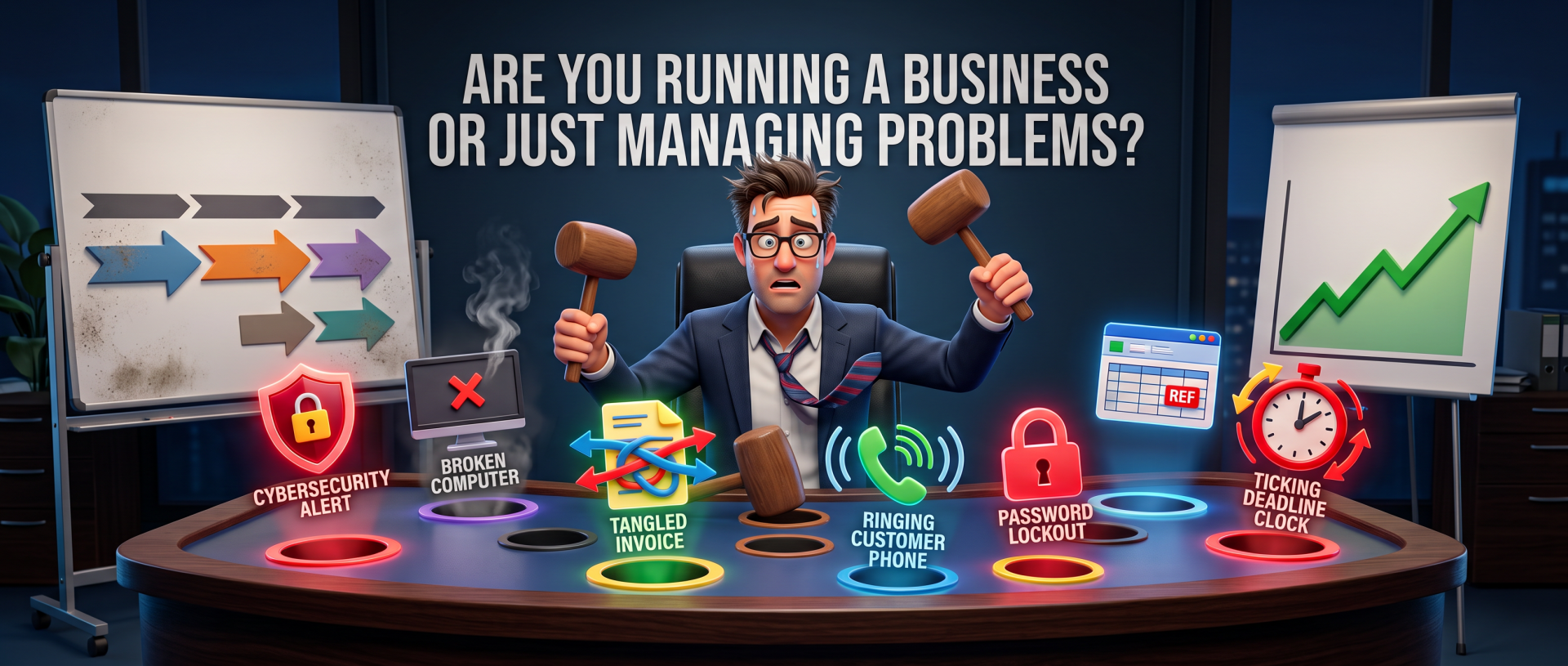
A practical guide to replacing firefighting with systems, strategy, and a little breathing room
There is a strange moment in the life of a business owner when you realize you have become extraordinarily good at solving problems you never wanted to have.
The printer is offline. Again.
Someone cannot log in.
An invoice went to the wrong customer.
The Wi-Fi has apparently developed emotions.
A vendor needs an answer immediately to a question they first mentioned six weeks ago.
Someone clicked something they absolutely, positively should not have clicked.
Meanwhile, the strategic plan you enthusiastically created in January is sitting in a folder somewhere, presumably enjoying a peaceful retirement.
Welcome to the difference between running a business and managing problems.
They can look remarkably similar from the inside. Both involve meetings, decisions, emails, phone calls, spreadsheets, employees asking questions, and a suspicious amount of coffee. But the outcomes are very different.
A business being run intentionally becomes more predictable, scalable, resilient, and capable of pursuing opportunities.
A business being run reactively becomes excellent at one thing:
Surviving Tuesday.
And unfortunately, Tuesday keeps coming back.
The Great Productivity Illusion
One of the sneakiest things about reactive management is that it feels productive.
You answered 47 emails. Resolved three customer complaints. Approved a purchase. Reset someone’s password. Called an insurance agent. Found the missing spreadsheet. Helped accounting figure out why something stopped synchronizing.
Look at you go.
You are a machine.
Unfortunately, you may also be a very efficient machine for converting business problems into slightly smaller business problems.
Activity and progress are not the same thing.
This distinction matters because modern work creates an extraordinary amount of activity. Microsoft’s research into what it calls the “infinite workday” found the average worker in its dataset received 117 emails and 153 Teams messages each weekday. The research also found that interruptions from meetings, email, and notifications could arrive approximately every two minutes during core working hours. [microsoft.com], [news.microsoft.com]
So if your day feels like someone turned your to-do list into a tennis-ball launcher, you are not imagining things.
The danger is that constant communication creates the sensation that everything is urgent. Once everything becomes urgent, people naturally optimize for immediate relief.
Fix the computer.
Answer the angry email.
Restore the deleted file.
Find the missing proposal.
Call the vendor.
Restart the server.
Congratulations. The organization made it to 5 p.m.
But did the business actually improve?
That is the question leaders need to start asking.
Problems Are Normal. Recurring Problems Are Data.
Every business has problems.
Good businesses have problems.
Bad businesses have problems.
Businesses apparently run by wizards riding unicorns almost certainly have problems too, although presumably their helpdesk tickets involve enchanted printers.
The difference is not the existence of problems. It is what happens after the problem.
Imagine your sales team repeatedly loses time because customer information is incomplete.
A reactive organization asks: “Who forgot to enter the information?”
An operationally mature organization asks: “Why does our process allow required information to be missing?”
That sounds like a subtle difference. It isn’t.
The first question looks for someone to fix today’s problem.
The second looks for a way to prevent tomorrow’s.
The same principle applies almost everywhere.
If employees routinely forget passwords, you can continue resetting passwords or redesign authentication.
If invoices routinely contain errors, you can correct invoices or fix the workflow producing them.
If employees repeatedly fall for convincing phishing messages, you can clean up individual incidents or combine technical controls with ongoing human cybersecurity education.
If backups fail without anyone noticing, you can cross your fingers or implement monitoring, testing, accountability, and recovery procedures.
A recurring problem is rarely just an annoyance.
It is information.
Your business is trying to tell you where the system is weak.
The Owner as Human Middleware
Here is another warning sign: nothing works without you.
Every decision goes through you.
Every exception goes through you.
Customers request you personally. Employees ask you questions that should not require your involvement. Vendors call you because nobody else knows what was agreed upon.
You have become human middleware.
This sounds flattering at first. It can even feel like evidence of good leadership.
“Nobody knows this place like I do.”
Exactly.
That may be the problem.
If the organization cannot function effectively unless one person’s brain is connected to it 14 hours a day, the company has not created a scalable operating system. It has created a very demanding job for one person.
There is an important difference.
Good leadership is not about becoming indispensable to every routine decision. It is about making the organization capable of making good decisions without requiring constant intervention from leadership.
That requires documented processes, clearly defined responsibilities, sensible technology, good information, training, and escalation paths.
The owner should not have to know that Sally in accounting prints a particular report, saves it to a desktop folder called “NEW FINAL REPORTS,” emails it to Steve, who manually copies six numbers into another spreadsheet before uploading it somewhere else.
That is not a business process.
That is a hostage situation involving Excel.
Your Calendar Knows the Truth
Want to determine whether you are building a business or operating an emergency room for corporate problems?
Look at your calendar.
Not what your website says.
Not the mission statement.
Your calendar.
How much time last month went toward:
- improving systems,
- developing employees,
- reviewing business metrics,
- strengthening customer relationships,
- evaluating risk,
- improving security,
- developing new products or services,
- improving sales and marketing,
- or planning where the company should go next?
Now compare that with the hours spent handling exceptions, preventable outages, repetitive approvals, miscommunication, troubleshooting, and issues that have happened before.
Those numbers tell a story.
The problem is not simply that reactive work consumes hours. It also consumes attention.
Microsoft’s research found that half of meetings in its dataset occurred during two periods it identifies as common high-productivity windows, 9 to 11 a.m. and 1 to 3 p.m. [microsoft.com]
When the best parts of the day are fragmented by alerts, meetings, inboxes, and operational emergencies, long-term thinking is frequently postponed.
And strategic work has one enormous disadvantage against emergencies:
Strategy rarely screams.
Nobody receives a flashing red alert declaring: WARNING: YOU HAVE FAILED TO IMPROVE YOUR CUSTOMER ONBOARDING PROCESS FOR 94 DAYS.
Maybe we need that software.
The Firefighter Problem
Business owners often admire great problem solvers, and understandably so.
When something catches metaphorical fire, these are the people who grab the extinguisher.
But businesses can accidentally reward firefighting so enthusiastically that nobody receives credit for fire prevention.
Suppose Employee A rescues a major project after three all-nighters.
Everyone applauds.
Employee B quietly redesigned a process six months earlier that prevented 30 similar emergencies.
Nobody notices.
Employee B receives no pizza.
This creates a strange cultural incentive. Heroics become visible while prevention disappears into the background.
IT departments know this problem especially well.
When technology works perfectly for 183 consecutive days, nobody walks into the IT office and announces:
“Fantastic DNS performance this quarter, everyone!”
But let the internet go down for seven minutes and suddenly the entire company develops a passionate interest in network architecture.
Strong operations make reliability boring.
That is the goal.
The absence of drama can actually be a sign that somebody is doing an excellent job.
Reactive Management Has a Human Cost Too
Constant crisis management isn’t only inefficient. It can wear down the people doing it.
Recent Gallup workplace research found global employee engagement fell to 20% in 2025, its lowest level since 2020. The organization also reported that declining manager engagement accounted for much of the recent downturn. [gallup.com], [gallup.com]
That should matter to business owners because managers often sit directly between strategy and operational reality.
They are the people translating ambitious goals into actual work while simultaneously fielding employee questions, customer needs, deadlines, technological changes, and unexpected problems.
If every week is an emergency, eventually emergency stops meaning anything.
People stop planning because plans always get interrupted.
They stop proposing improvements because nobody has time to implement them.
Eventually, “That’s just how we do it here” becomes less of an explanation and more of a surrender.
Technology Can Solve Problems. It Can Also Industrialize Them.
Modern businesses have an astonishing selection of technology available.
Cloud platforms. Automation. CRM systems. AI. Cybersecurity tools. Collaboration platforms. Analytics dashboards.
Wonderful.
But adding technology to a broken process can produce a fascinating result: a broken process that runs faster.
If employees manually enter the same information into four systems, buying a fifth system probably doesn’t count as transformation.
Before buying another tool, leaders should ask: What business problem are we solving?
Then: Why does that problem exist?
Then: Should technology solve it, or should the process change first?
Those questions become especially important with AI. IBM’s 2025 breach research warned that organizations were adopting AI without corresponding security and governance. Its study covered 600 organizations that experienced data breaches between March 2024 and February 2025, across 17 industries and 16 countries and regions. [www-api.ibm.com]
Innovation without governance is merely a new category of future meeting.
Probably an urgent one.
The real objective is not to accumulate technology.
It is to build a business in which technology supports intentional processes, people understand those processes, leadership can see whether those processes work, and risks are managed before they become emergencies.
The Five Questions That Move You Out of Firefighting Mode
If your organization feels permanently reactive, you do not necessarily need a 96-page transformation plan with inspirational stock photography.
Start smaller.
1. What keeps happening?
Review your recurring support requests, complaints, outages, security issues, missed deadlines, rework, and manual fixes.
Patterns matter more than individual incidents.
A problem experienced five times should no longer be treated as five separate surprises.
2. What depends on one person?
Look for processes where only one employee knows what to do, where information lives inside someone’s inbox, or where a vacation creates operational panic.
Those are business continuity risks wearing ordinary office clothes.
Document the process. Cross-train someone. Assign ownership. Centralize important information appropriately.
3. What are people doing manually that should be automated?
Automation is particularly useful for repetitive, predictable, rules-based work.
But automate thoughtfully.
Taking a terrible workflow and automating every step simply ensures you can perform nonsense at unprecedented speed.
4. What are we repeatedly fixing instead of preventing?
This is a particularly useful question for IT and cybersecurity.
If endpoints keep generating the same issues, identify the root cause.
If users continually receive dangerous email, examine security controls and training.
If systems fail unpredictably, improve monitoring.
If backups exist, test whether they can actually be restored.
A checkbox saying Backup: Yes is much less comforting when nobody has tried the Restore half of the equation.
5. What would break if we doubled tomorrow?
This may be the most revealing question.
If you doubled your customers, transactions, employees, locations, or revenue tomorrow, what would collapse first?
Your answer points directly toward your next operational constraint.
Growth does not repair weak systems.
Growth finds them.
Then it introduces them to everybody.
From Chief Problem Solver to Business Builder
The shift from reactive management to intentional leadership does not require eliminating every surprise.
That would be nice, but businesses stubbornly continue interacting with customers, employees, vendors, computers, weather, governments, and the internet.
Things will happen.
The objective is to change the ratio.
Spend less leadership energy repeatedly repairing predictable failures and more of it designing an organization where fewer failures reach leadership in the first place.
That means turning tribal knowledge into documented processes.
Turning repetitive labor into appropriate automation.
Turning IT from “the people we call when something breaks” into a business capability.
Turning cybersecurity from an annual compliance exercise into ongoing risk management.
Turning data into decisions.
And turning recurring emergencies into root-cause investigations.
You do not stop solving problems.
You start solving better problems.
Instead of asking, “Why isn’t this computer working?” leadership can ask, “How can technology help us serve customers better?”
Instead of “Who forgot to send this?” ask, “Can this workflow eliminate the need to remember?”
Instead of “How quickly can we recover from this incident?” ask, “How do we reduce the probability and impact of the next one?”
That is where running a business begins to feel very different from merely maintaining one.
Where an MSP Fits Into This
A managed service provider can be useful when technology itself has become one of the organization’s recurring sources of reactive work.
For businesses without extensive internal IT resources, an MSP such as Ethixa Solutions can help establish disciplines around areas such as proactive monitoring, patching, cybersecurity controls, backups, technology planning, user support, documentation, and standardization.
The important word is proactive.
The goal should not simply be having someone new to call when the server catches fire.
It should be reducing how often you need to make that call.
A productive MSP relationship should also connect technology decisions to business needs. What is approaching end of life? Where are the operational bottlenecks? Which risks deserve attention? Which processes can reasonably be automated? Is the business planning growth that current technology will struggle to support?
IT is most valuable when it becomes part of those conversations before the problem appears.
Your Business Should Not Need a Hero Every Day
There will always be tough weeks.
A customer will surprise you. A vendor will fail. A system will misbehave. Someone will accidentally delete something important despite a filename that literally says DO_NOT_DELETE.
That is business.
But if every day requires heroics, heroism is no longer the solution.
The system is the problem.
Strong businesses still encounter problems. They simply become better at distinguishing a genuine surprise from a recurring weakness.
They document.
They automate.
They measure.
They train.
They monitor.
They plan.
And most importantly, they leave enough room in the day to think about where the business is going instead of spending every hour rescuing it from where it has already been.
So tomorrow morning, before opening your inbox and discovering which tiny emergency has volunteered to become your entire personality for the day, ask yourself one question: Am I running this business today, or am I just managing its problems?
The answer may be uncomfortable.
It may also be one of the most valuable business metrics you have.
Leave a Reply