

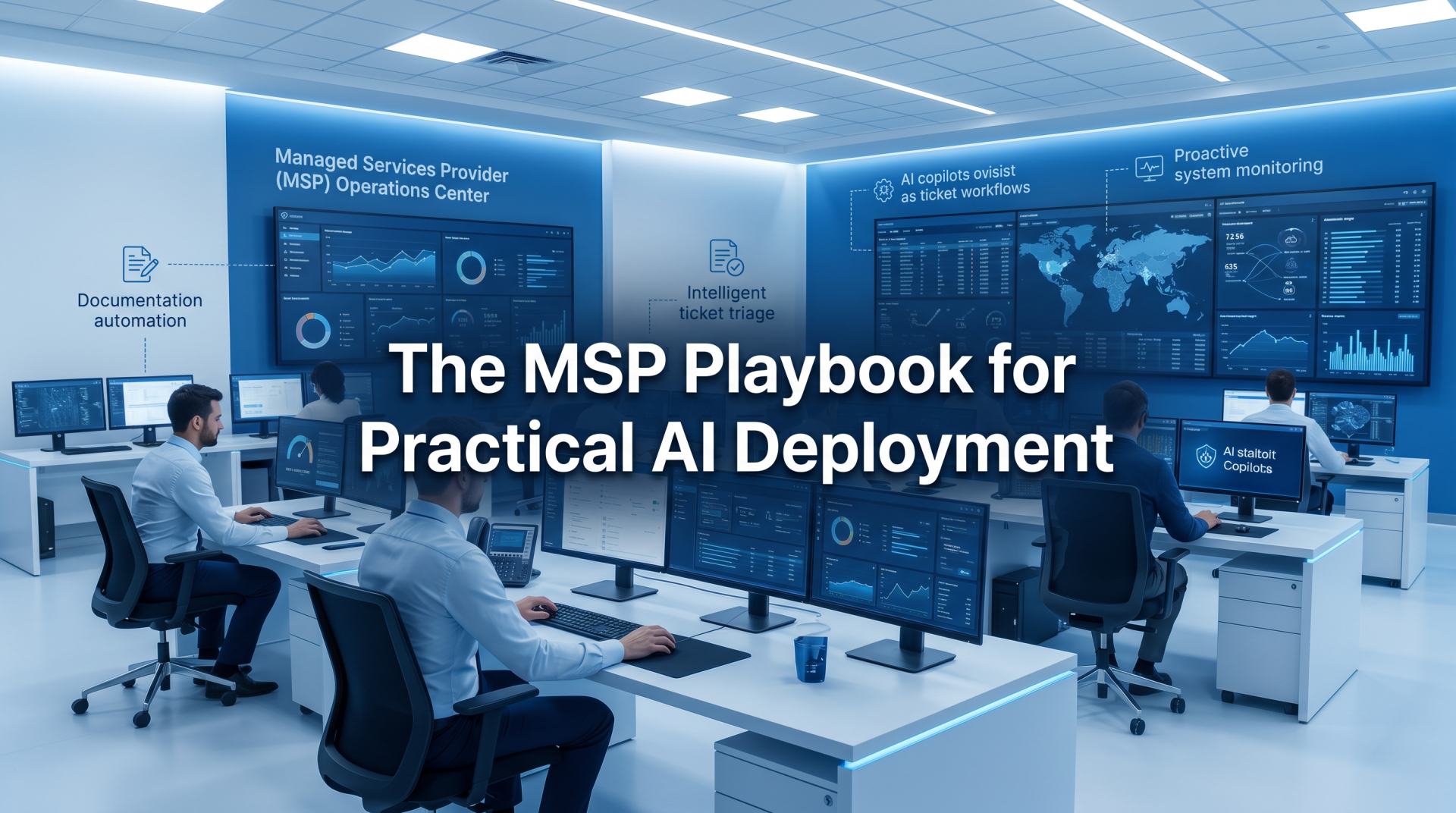
Artificial intelligence has moved from conference-stage hype to real operational tooling for managed service providers. The important shift is not that AI exists. The important shift is that mainstream MSP platforms already expose practical capabilities for service desk work, scripting, security triage, documentation, and reporting. ConnectWise currently markets Sidekick with ticket summarization, translation, auto-triage, email response generation, sentiment tracking, AI-assisted scripting, and natural language security workflows. Kaseya’s Cooper Copilot documentation describes smart ticket summaries, writing assistance, and smart resolution summaries. Atera’s AI Copilot page describes instant ticket summaries, real-time device troubleshooting, script generation, command-line generation, and knowledge base connections. In other words, for MSPs, this is no longer theoretical. The tooling is here now. [connectwise.com], [help.bms.kaseya.com], [atera.com]
The more strategic question is where to use AI first. That matters because MSP economics have always been shaped by labor intensity, SLA pressure, and the need to scale service quality without scaling headcount at the same rate. Forrester wrote in December 2024 that service providers need to reinvent around asset-based, solution-driven, and outcome-oriented models as generative AI changes how knowledge work gets delivered. In a separate Forrester post on managed services, the firm described AI-led services as a new paradigm that blends automation, performance-based models, and human refinement. CompTIA’s 2025 and 2026 outlook material emphasizes that software, workflow redesign, automation, and skills development are central to how organizations translate AI into business value. [forrester.com], [forrester.com], [comptia.org], [comptia.org]
That combination of platform maturity and economic pressure is why the best MSP AI strategy is practical, not flashy. The winners are not the providers with the most AI branding. The winners are the providers that deploy AI in a few repeatable workflows where it cuts response times, removes low-value toil, improves consistency, and creates more capacity for senior engineers and account managers. Below are the highest-value use cases MSPs can deploy today, along with the guardrails that keep them useful and safe.
1.) AI-Powered Ticket Triage and Service Desk Acceleration
The service desk is usually the first and best AI landing zone for an MSP because it concentrates repetitive work, context switching, and language-heavy tasks. ConnectWise says Sidekick for PSA includes more than 70 AI-assisted actions and highlights ticket summarization, ticket translation, auto-triage, email response generation, and customer sentiment tracking. Kaseya’s Cooper Copilot documentation describes Smart Ticket Summary, Smart Writing Assistant, and Smart Resolution Summary. Atera describes instant ticket summaries as a standard AI Copilot capability. Microsoft’s Copilot Studio documentation for its IT Helpdesk template says an agent can use an organization’s knowledge base to answer technical questions, help create ServiceNow tickets when it cannot resolve an issue, and let users check ticket status. [connectwise.com], [help.bms.kaseya.com], [atera.com], [learn.microsoft.com]
For an MSP, this translates into immediate operational value. A dispatcher can understand a long ticket thread faster. A technician can see the current state of the issue without reading every note. A multilingual client base becomes easier to serve consistently because ticket translation and language detection reduce friction at intake. Resolution notes become more readable for customers. Escalations become cleaner because the issue history is already condensed into useful context. None of that replaces engineers. It simply moves more of their time away from reading, rewriting, and reclassifying and toward solving. The most practical deployment pattern is to use AI first for summarization, categorization, and response drafting, because those are the lowest-friction, highest-volume tasks in most MSP service desks. [connectwise.com], [help.bms.kaseya.com], [atera.com], [learn.microsoft.com]
2.) Documentation, SOP Creation, and Knowledge Base Growth
Documentation is one of the most underappreciated AI opportunities for MSPs because it directly affects onboarding speed, service consistency, and engineer productivity. Atera says its AI Copilot can connect to a company knowledge base and automatically turn ticket resolutions into ready-to-use knowledge base articles. Kaseya’s April 2025 release announcement says Cooper Copilot in IT Glue can generate step-by-step SOPs in real time, and Kaseya’s Spring 2025 release notes again describe AI-driven SOP generation for IT Glue. Microsoft’s IT scenario library says Copilot can be used to revise support documentation in simpler language and draft clarifications to reduce repeated user questions. [atera.com], [kaseya.com], [kaseya.com], [adoption.m…rosoft.com]
This matters because most MSPs do not suffer from a lack of technical knowledge. They suffer from fragmented knowledge. The senior engineer knows the workaround. The service coordinator knows the client’s preferences. The vCIO knows the business context. The challenge is getting that information out of people’s heads and into repeatable operating assets. AI helps by converting ticket history, field notes, and successful resolutions into SOPs, KB articles, and cleaner client-facing documentation. When done well, that creates a compounding effect: better documentation improves future ticket handling, which improves future documentation, which shortens future onboarding and escalation cycles. This is one of the rare AI use cases that improves both efficiency and enterprise value, because it turns tribal knowledge into reusable intellectual property. [atera.com], [kaseya.com], [kaseya.com], [adoption.m…rosoft.com]
3.) Technician Copilots for Scripting, Troubleshooting, and Remediation
One of the clearest signs that AI is genuinely usable for MSPs is that major platforms already embed it in technician workflows, not just chat windows. ConnectWise says Sidekick for Automate and Sidekick for RMM can create, review, and run PowerShell, batch, and bash scripts, while also stating that generated scripts require human review or approval before execution. Atera says its AI Copilot can generate scripts from plain-text instructions, produce command-line syntax, run health checks, diagnose device issues, suggest actions, and resolve issues on Windows and macOS devices. Cisco’s AIOps explanations define AIOps as the use of AI and machine learning to automate IT operations processes such as event correlation, anomaly detection, and causality determination, and describe how AIOps platforms ingest infrastructure and ticketing data, maintain dynamic baselines, and automate remediation, ticket creation, and notifications. [connectwise.com], [atera.com], [cisco.com], [developer.cisco.com]
For MSPs, this use case is where AI starts to feel less like writing assistance and more like an operations multiplier. A junior or mid-level technician can move faster because the assistant helps generate a starter script, the right command syntax, or the next diagnostic step. That does not remove the need for judgment. It reduces the cost of getting to judgment. It also helps standardize remediation quality across the team. Instead of every technician writing a slightly different script or following a slightly different process, the organization can converge faster on cleaner, reviewed automations. The reason this is deployable today is that it is already embedded in RMM and PSA-adjacent products, and the better vendors are explicit that humans remain in control before anything sensitive runs in production. [connectwise.com], [docs.connectwise.com], [atera.com], [developer.cisco.com]
4.) Security Operations, Phishing Triage, and Alert Review
Security is another high-return AI use case because the work is repetitive, time-sensitive, and often buried in noise. Microsoft’s documentation says the Phishing Triage Agent in Microsoft Defender is an AI agent that helps security teams scale the triage and classification of user-reported phishing emails, using large language model analysis to determine intent, classify submissions, provide transparent rationale, and learn from analyst feedback. Microsoft’s Security Alert Triage Agent documentation says the agent helps security teams triage alerts at scale, classify alerts across supported workloads, identify false positives versus malicious activity, and provide clear reasoning for its decisions. ConnectWise says Sidekick for Security lets MSPs query with natural language to understand customer security posture, discover threat intelligence trends, and simplify response actions. [learn.microsoft.com], [learn.microsoft.com], [connectwise.com]
For an MSP running managed security or even a lighter-weight security practice, this is one of the most practical AI deployments available. User-reported phishing queues are a perfect example: they are operationally important, highly repetitive, and too often consume analyst time that should be spent on confirmed threats. AI can screen the queue, classify obvious false positives faster, escalate more credible threats, and provide rationale that a human can quickly review. Even for MSPs not running a full SOC, AI-assisted security posture queries, alert triage, and enrichment make it easier to deliver security value without overwhelming the team. The point is not to let AI “own security.” The point is to let AI absorb repetitive triage so human analysts can spend more time on investigation, communication, containment, and higher-order client advice. [learn.microsoft.com], [learn.microsoft.com], [connectwise.com]
5.) Proactive Monitoring, Anomaly Detection, and Noise Reduction
A large part of MSP inefficiency comes from alert fatigue. Too many alerts are duplicates, low-priority notices, or incomplete signals that force technicians to reconstruct what actually matters. Cisco’s AIOps materials describe core AIOps functions such as event correlation, anomaly detection, dynamic baselines, contextualized information, root cause analysis, and automated remediation workflows. Cisco also gives an example where a network management system detects a problem, diagnoses it, and signals IT service management to create a ticket. Atera says its AI Copilot can provide account insights on demand, summarize remote sessions, troubleshoot devices in real time, and generate commands directly on devices. Kaseya’s platform messaging describes “digital specialists” for routine tasks like ticket triage and “smart insights” that connect data points across client environments. [cisco.com], [developer.cisco.com], [atera.com], [kaseya.com]
This is the operational center of gravity for MSP AI over the next few years. The near-term goal is not fully autonomous infrastructure. The near-term goal is better signal quality. If AI can correlate alerts, summarize what changed, identify likely root causes, and suppress obvious noise, technicians can work from incidents instead of fragments. That improves mean time to acknowledge, mean time to resolution, and client confidence. It also creates a more believable “proactive support” story. Many MSPs already promise proactivity. AI-backed anomaly detection and contextualized alert handling help them deliver it in a more tangible way. [cisco.com], [developer.cisco.com], [atera.com], [kaseya.com]
6.) Client Reporting, QBRs, vCIO Work, and Upsell Discovery
Not every valuable AI use case sits inside a ticket queue. Some of the strongest business benefits appear in account management and strategic reporting. ConnectWise says Sidekick offers access to PSA records and business insights, and specifically lists business opportunity insights as a feature. Kaseya’s Kaseya 365 Ops materials describe AI-driven workflows, automated reporting, QBRs and executive reports through myITprocess, and quoting and hardware procurement through Quote Manager. Atera’s AI Copilot playbook includes examples such as identifying trends in support tickets and spotting upsell opportunities within tickets. [connectwise.com], [kaseya.com], [atera.com]
For the modern MSP, this is a major commercial opportunity. AI can surface patterns in recurring incidents, aging assets, repeated support requests, security concerns, and underused licenses that point to an upgrade, project, or policy conversation. It can also help turn raw operational data into executive-ready reporting. That makes QBRs stronger because the conversation becomes less about dumping metrics and more about explaining business implications. An MSP that uses AI to create sharper, more contextual client reporting is not just saving internal time. It is increasing its ability to prove value, support renewals, and identify next-best-service opportunities without relying entirely on manual analysis. [connectwise.com], [kaseya.com], [atera.com]
7.) Internal Operations, Back-Office Efficiency, and Multilingual Support
MSPs should not restrict AI to technical delivery. Back-office workflows are often full of repetitive writing, classification, and data-entry work that AI can streamline. Kaseya 365 Ops describes integrated billing, contract management, quoting, accounts receivable automation, and automated reporting, all tied together with AI-driven workflows and deep integrations. Kaseya’s Cooper Copilot documentation says the system can detect input language automatically and respond in the same language for supported ticketing workflows. ConnectWise says Sidekick can surface PSA records and business insights inside Microsoft Teams. Microsoft’s IT scenario library says Copilot can help teams revise policy language and draft updates based on common user questions. [kaseya.com], [help.bms.kaseya.com], [connectwise.com], [adoption.m…rosoft.com]
That matters because internal friction quietly destroys MSP margin. Every minute spent rewriting notes, translating requests, chasing status, building a basic summary for a manager, or reformatting operational data is time that cannot be spent solving a client problem or building a new service. AI is especially effective when it sits inside the systems people already use. That is why the current generation of platform-native assistants is more practical than generic chat tools. The best AI deployment is usually the one that shortens existing workflows instead of creating brand-new ones. [kaseya.com], [help.bms.kaseya.com], [connectwise.com], [adoption.m…rosoft.com]
The Guardrails That Separate Useful AI from Risky AI
The real risk for MSPs is not moving too slowly. It is deploying AI carelessly. NIST says the AI Risk Management Framework is intended for voluntary use to improve the ability of organizations to incorporate trustworthiness considerations into the design, development, use, and evaluation of AI products, services, and systems. NIST’s Generative AI Profile says the profile can help organizations identify risks unique to generative AI and proposes actions for risk management aligned to organizational goals. Microsoft’s Copilot Studio guidance on autonomous agents says organizations should define clear scope, provide quality data and instructions, test thoroughly, roll out gradually, use human oversight for critical actions, and apply least-privileged access. [nist.gov], [nist.gov], [learn.microsoft.com]
Vendors are also explicit about these boundaries in their own tooling. ConnectWise says AI-generated scripts require review or approval before running. Kaseya’s Cooper Copilot documentation says generated content may contain errors and should be reviewed before use or distribution. That is exactly the right operating model for MSPs. Use AI aggressively where it accelerates understanding, drafting, pattern recognition, and recommended next steps. Keep humans in the loop for approvals, sensitive actions, customer communication in edge cases, and anything with material security or compliance impact. Responsible AI in an MSP is not about avoiding automation. It is about matching autonomy to risk. [connectwise.com], [docs.connectwise.com], [help.bms.kaseya.com], [learn.microsoft.com]
A Practical Rollout Sequence for MSPs
The most effective rollout is usually staged. My recommendation is to start with service desk summarization and response drafting, then add documentation generation, then move into scripting and security triage, and only after that expand into autonomous workflows. That sequence works because it starts with low-risk tasks where AI creates obvious time savings, then gradually moves into higher-leverage actions where stronger review and governance are needed.
A second recommendation is to choose one platform-native AI workflow per team rather than launching a broad “AI transformation” initiative. For example, dispatch might start with auto-triage and summaries, service desk with note enhancement and KB generation, engineering with reviewed script generation, security with phishing triage, and account management with AI-assisted QBR prep. That gives leadership measurable wins without creating a messy, disconnected tool sprawl.
A third recommendation is to define success in operational terms, not marketing terms. Good metrics include technician time saved on ticket handling, reduction in first-response lag, fewer escalations caused by poor documentation, faster alert triage, faster QBR preparation, and more consistent resolution notes. If an AI feature does not improve one of those outcomes, it is interesting technology, not a useful MSP capability.
How MSPs Such as Ethixa Solutions Can Help
For MSPs such as Ethixa Solutions, the strongest AI story is not “we use AI everywhere.” It is “we apply AI where it makes your environment easier to support, more secure, and more predictable.” In practice, that means starting with a service desk assistant that shortens ticket handling, connecting AI to documentation so client knowledge becomes durable, using AI to support secure remediation and security triage, and then turning the resulting operational data into clearer executive reporting and roadmap conversations.
This is also where a well-run MSP can differentiate itself from competitors that merely resell tools. Clients need a partner that can decide where AI belongs, where it does not, and how it should be governed. An MSP that can pilot AI in a narrow use case, document the workflow, train staff, measure the result, and then expand carefully is far more credible than one that treats AI as a blanket promise. The market is moving from AI curiosity to AI accountability, and that rewards MSPs that combine technical execution with clear operational design.
Final Thoughts
The practical AI opportunity for MSPs is not a single killer app. It is a stack of small, compounding improvements across ticket handling, documentation, troubleshooting, security, monitoring, and reporting. What makes this moment different is that major MSP platforms and Microsoft’s AI tooling already expose deployable capabilities for these workflows. The best move now is not to wait for perfect autonomy. It is to deploy AI in the places where your team already feels repetitive strain and operational drag, then add governance, measurement, and iteration as you scale. [connectwise.com], [help.bms.kaseya.com], [atera.com], [learn.microsoft.com], [learn.microsoft.com], [nist.gov]
Leave a Reply